
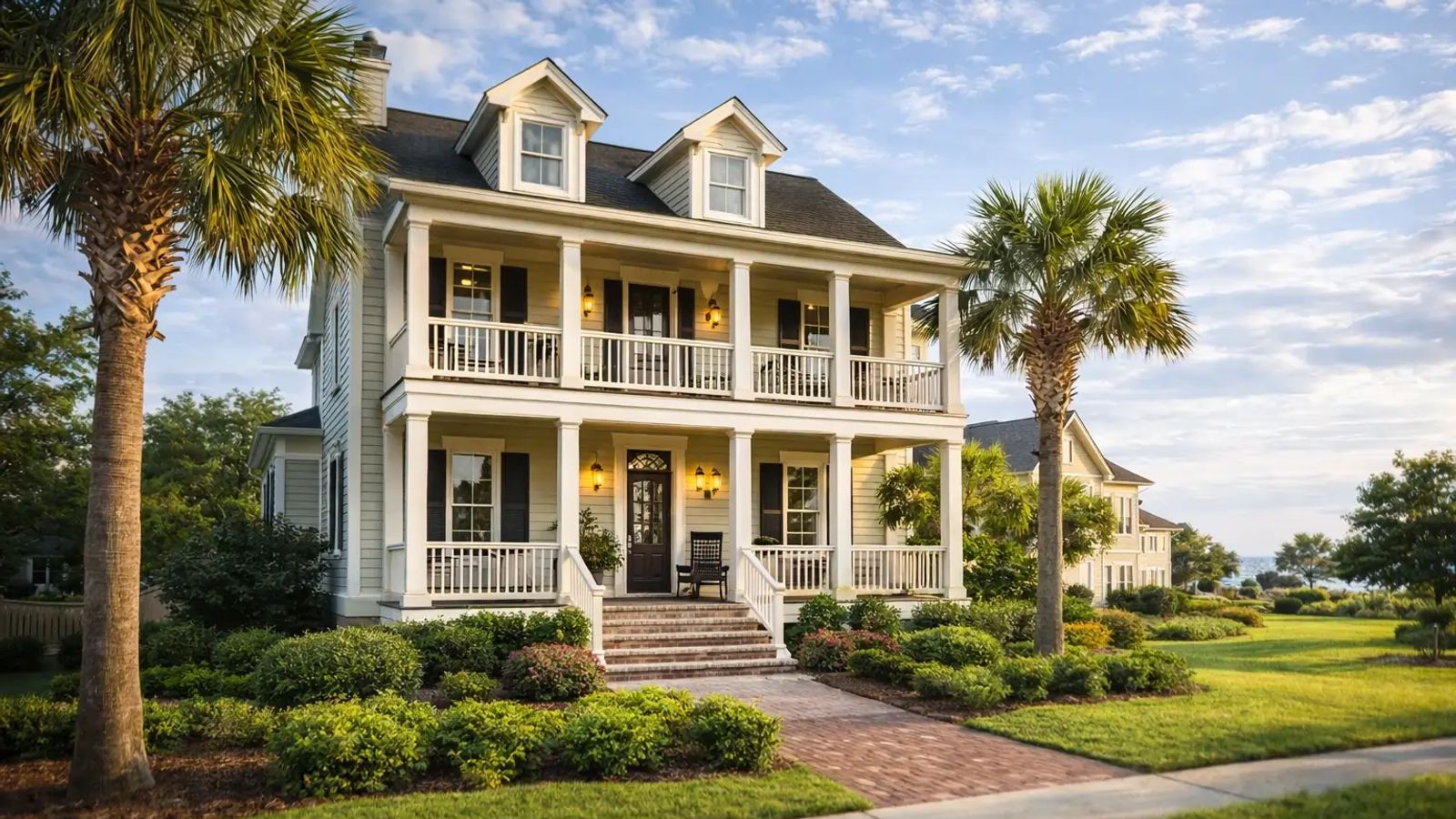
Homeowners Insurance in Goose Creek and Charleston, SC
South Carolina's coast brings beauty, and real risk. Hurricanes, flooding, wind damage, and rising rebuild costs mean your home needs more than a standard policy. As an independent agency, we shop our carrier network to find coverage designed for where you actually live.

Is Your Lowcountry Home Actually Covered?
Coastal South Carolina homeowners often face a combination of risks that can quietly outpace their coverage: hurricane season, named storm deductibles, flood zones, and rebuild costs that have risen sharply across the Charleston area in recent years.
Many homeowners in Goose Creek, Summerville, Mount Pleasant, North Charleston, and West Ashley discover at claim time that their dwelling coverage no longer reflects what it would actually cost to rebuild. Others find their wind and hail deductible is percentage-based, meaning thousands out of pocket , rather than the flat dollar amount they assumed. Flood damage is typically excluded from standard homeowners policies entirely and requires a separate policy to cover.
We work with admitted carriers licensed and regulated in South Carolina. We review your dwelling limits, your named storm and wind deductible structure, your roof settlement terms, and your flood exposure, then find coverage that fits your home and your actual risk. Not just your zip code.
A five-minute conversation could reveal gaps you didn't know you had.
Coverage Options
Comprehensive Protection for Your Home
A well-built homeowners policy protects far more than your walls and roof. Here's what we include.
Dwelling Protection (Coverage A)
Dwelling coverage is designed to help pay for damage to the structure of your home, the walls, roof, floors, built-in appliances, and attached structures like a garage, when caused by a covered peril. Most policies we review for Lowcountry homeowners include fire, wind, hail, and lightning as covered perils. Coverage limits, exclusions, and deductibles vary by policy and carrier. We help you understand what your dwelling limit actually covers and whether it reflects current rebuild costs in your area.
Get My Home Quoteabout Dwelling Protection (Coverage A)Other Structures (Coverage B)
Other structures coverage typically applies to structures on your property that are not attached to your main dwelling, such as a detached garage, fence, shed, dock, or gazebo. This coverage is commonly set at a percentage of your dwelling limit, which may or may not be sufficient depending on what you have on your property. If you have a detached workshop or a guest cottage, it's worth reviewing whether your other structures limit is adequate for your actual exposure.
Get My Home Quoteabout Other Structures (Coverage B)Personal Property (Coverage C)
Personal property coverage is designed to help reimburse you for furniture, clothing, electronics, appliances, and other belongings if they are damaged, destroyed, or stolen by a covered peril. How your policy settles a personal property claim matters significantly. Replacement cost coverage pays to replace items with new equivalents, while actual cash value coverage factors in depreciation, which can result in a substantially lower payout. High-value items such as jewelry, firearms, fine art, and collectibles may have sublimits under a standard policy and may require a separate scheduled endorsement for full coverage.
Get My Home Quoteabout Personal Property (Coverage C)Loss of Use (Coverage D)
Loss of use coverage, sometimes called additional living expenses, is designed to help pay for temporary housing, meals, and other increased living costs if a covered loss makes your home uninhabitable while repairs are underway. Coverage limits and the duration of benefits vary by policy. We encourage clients to review their loss of use limit relative to actual rental costs in their area, as housing costs in the greater Charleston market have increased significantly in recent years.
Get My Home Quoteabout Loss of Use (Coverage D)Liability (Coverage E)
Personal liability coverage is designed to help protect you if someone is injured on your property or if you cause damage to someone else's property, and a claim or lawsuit results. This can include situations such as a slip-and-fall on your premises, a dog bite, or accidental damage caused by a household member subject to your policy limitations. Liability coverage under a homeowners policy has limits, and for homeowners with significant assets, those limits may not be sufficient. A personal umbrella policy can provide an additional layer of liability protection above your base homeowners limits.
Get My Home Quoteabout Liability (Coverage E)Medical Payments (Coverage F)
Medical payments coverage is designed to help pay for reasonable medical expenses for guests who are accidentally injured on your property. This coverage is typically limited in scope and dollar amount and is not a substitute for health insurance or personal liability coverage. It is intended to cover minor incidents and help avoid small claims from escalating into larger liability situations. Coverage limits, terms, and conditions vary by policy and carrier.
Get My Home Quoteabout Medical Payments (Coverage F)
Roof Claims in South Carolina: How Settlement Terms Affect Your Payout
Roof damage is one of the most common homeowners claims in South Carolina, and how your policy settles that claim matters as much as whether it covers it. Two policies can both "cover" a roof claim and result in very different payouts depending on the settlement terms written into your policy.
Replacement cost settlement pays to repair or replace your roof with materials of like kind and quality, without deducting for age or wear. Actual cash value settlement factors in depreciation, meaning an older roof may result in a significantly lower payout even for the same damage. Some carriers in the coastal South Carolina market have shifted to ACV-only roof settlement on policies in high-wind exposure areas. Others offer replacement cost as a standard or optional provision.
We review your roof settlement terms at every policy review, not just at purchase, so you understand what to expect before you ever need to file a claim. Coverage terms, conditions, and availability vary by carrier and policy. A licensed agent can walk you through the specific language in your policy.

Understanding Your Home Insurance Deductibles in Coastal South Carolina
Most homeowners in South Carolina, particularly in coastal markets like Goose Creek, Summerville, and the greater Charleston area, carry more than one deductible on their homeowners policy, and many don't realize it until they file a claim. Understanding your deductible structure before a loss occurs is one of the most important steps you can take as a Lowcountry homeowner.
All Other Perils (AOP): Your standard deductible typically applies to many covered losses under the policy. Common examples include fire and theft, though covered perils vary by policy form and carrier. This deductible is commonly a flat dollar amount, though terms vary.
Wind & Hail Deductible: A separate deductible that may apply specifically to wind and hail damage. In coastal South Carolina markets, this deductible is commonly percentage-based rather than a flat dollar figure, often in the range of 1–5% of your dwelling coverage amount. As an example, a home insured for $400,000 with a 2% wind deductible would carry an $8,000 , though actual amounts vary by policy, carrier, and coverage terms.
Named Storm / Hurricane Deductible: Some carriers writing in coastal South Carolina apply a third separate deductible when damage is associated with a named tropical storm or hurricane. The terms "named storm deductible" and "hurricane deductible" are sometimes used interchangeably but may carry different trigger definitions depending on the specific policy language. Whether this deductible applies is determined by the policy language and carrier guidelines, not simply by whether a storm made landfall.
Deductible structures, percentages, trigger definitions, and terms vary by carrier and are subject to policy conditions and limitations. We walk through your deductible structure with every client at purchase and at each renewal to help you understand your out-of-pocket exposure, and we always encourage clients to review their full policy documents, as the policy language controls in all cases. If you have questions about your current deductibles, call us at (843) 793-3168.

How Your Homeowners Policy Form Affects What You Collect on a Claim
Not all homeowners policies are written the same way. The coverage form your policy is written on, and whether it settles losses on a replacement cost or actual cash value basis, directly affects how much you receive when you file a claim.
Basic, Broad, and Special Forms: Homeowners policies are written on different coverage forms that define which losses are covered and how. A Special Form policy covers your dwelling on an open-perils basis, meaning all causes of loss are covered unless specifically excluded. Basic and Broad Form policies cover only named perils. If the cause of loss isn't listed in the policy, it isn't covered. For personal property, even a Special Form policy typically defaults to named-perils coverage unless a broader endorsement is added. Coverage forms available and their terms vary by carrier.
Replacement Cost vs. Actual Cash Value on the Dwelling: A replacement cost policy pays to rebuild or repair your home at current construction costs, without deducting for depreciation. An actual cash value policy factors in the age and condition of materials, which can result in a meaningfully lower settlement on an older home. In a market where construction costs have risen sharply across the Charleston area, having your dwelling insured at current replacement cost, not purchase price or market value, is essential.
Coverage forms, settlement basis, terms, conditions, exclusions, and limitations are determined by the policy issued and vary by carrier. We review your policy form and settlement terms with every client to make sure your coverage reflects your home's actual replacement exposure.
What Home Insurance Covers

Home Insurance Questions — Answered
Homeowners insurance costs in South Carolina vary significantly based on your home's location, age, construction type, roof condition, proximity to the coast, and the coverage limits and deductibles you choose. Coastal and Lowcountry properties, including homes in Goose Creek, Summerville, Hanahan, and the greater Charleston area, typically carry higher premiums than inland properties due to wind and hurricane exposure. The best way to understand your actual cost is to compare quotes across multiple carriers. In Berkeley, Dorchester, and Charleston: $1,000 - $4,000, primarily based on age, roof year, size/coverage amount, and distance to coast.
Homeowners in Goose Creek and the greater Charleston area face a specific set of risks that don't apply everywhere: named storm exposure, percentage-based wind deductibles, flood zones near the tidal creek systems, and rapidly rising rebuild costs across Berkeley County. A policy that works well in the Midwest may leave a Goose Creek homeowner significantly underinsured. When reviewing a policy for this market, we focus on dwelling coverage relative to current rebuild costs, wind and named storm deductible structure, flood exposure and whether a separate flood policy is warranted, roof settlement terms, and personal property coverage limits. We work with carriers that specifically write in coastal South Carolina markets and understand these exposures.
Going directly to a single insurance company means you only see that company's products and pricing. An independent agency like Cheri Nelson Insurance Agency works with multiple carriers. In our case, many top rated carriers and can compare rates and coverage options across the market on your behalf. For homeowners in coastal South Carolina, this matters especially because not all carriers write in this market, and those that do have significantly different appetites for risk, deductible structures, and coverage terms. An independent agent can also advocate for you at claim time and help you navigate the process, something a direct carrier's call center typically cannot replicate.
The fastest way is to call our office directly at (843) 793-3168 or fill out our online quote request form. We'll ask about your home's age, construction, square footage, roof type and age, current coverage and more if applicable, and any specific concerns you have about your coverage. From there we shop our network of top rated carriers and present you with options. Most clients receive quote comparisons within the same day or one business day depending on complexity and underwriting. There's no obligation and no pressure, our job is to make sure you have the right information to make a good decision for your home.
Several factors can reduce your homeowners insurance premium without reducing your coverage meaningfully. A newer or recently replaced roof typically results in lower premiums, as roof age and condition are major pricing factors in coastal markets. Installing wind mitigation features such as hurricane straps, impact-resistant windows, , may qualify you for wind mitigation credits under South Carolina rating guidelines, depending on your carrier. Bundling your home and auto insurance with the same carrier often produces a multi-policy discount. Increasing your AOP deductible can lower your base premium, though we recommend carefully evaluating how that tradeoff works with your wind/hail and/or named storm/hurricane deductible before making changes. As an independent agency, we re-shop your home insurance at every renewal to make sure you're still on the most competitive option available.
Refer to: Understanding Your Home Insurance Deductibles in Coastal South Carolina (above on this page)
- All Other Perils (AOP)
- Wind & Hail Deductible
- Named Storm / Hurricane Deductible
High-value home insurance is coverage designed for homes with higher replacement costs, unique architectural features, or specialty contents that exceed standard policy limits. In the Charleston area, historic downtown homes, waterfront properties on Daniel Island or Sullivan's Island, and luxury builds in Mount Pleasant often require coverage that standard carriers don't write. High-value policies typically offer higher dwelling limits, cash-out replacement options, broader contents protection for art and collectibles, and specialized claims handling. If your home is valued above $750,000 or has features like custom millwork, a pool house, or a dock, ask us about carriers that write specifically for high-value Charleston-area properties.
Coastal and waterfront properties in South Carolina carry risks that standard homeowners policies are often not built to handle: higher wind exposure, storm surge (which homeowners insurance doesn't cover and requires flood insurance separately), salt air corrosion, and stricter underwriting. Properties within a certain distance of the coast may be declined by standard carriers entirely, or written with higher wind and named storm deductibles. We specialize in coastal placements for clients in Mount Pleasant, Isle of Palms, Sullivan's Island, Folly Beach, Daniel Island, and throughout the Lowcountry, working with carriers that understand these exposures and write coastal risks every day.
Get Your Free Home Insurance Quote
Tell us about your home and we'll compare options from 70+ carriers, including specialists in coastal South Carolina properties.
Get In Touch
Contact Us Directly
Phone
Address
Goose Creek, SC 29445
Is Your Home Really Protected?
Most Lowcountry homeowners have gaps they don't know about: flood exclusions, outdated dwelling limits, or inadequate wind coverage. Let us review your policy for free.
Homeowners Insurance Across the Charleston Lowcountry
Every Lowcountry neighborhood has its own insurance profile. Proximity to the coast, flood zone classification, building age, and carrier appetite vary significantly from Goose Creek to Sullivan's Island. As a local independent agency based in Goose Creek, we write homeowners insurance across the greater Charleston area and know what to expect in each market.
- Goose Creek — Established residential market with a mix of newer construction and older homes. Inland exposure but still subject to wind and named storm deductibles.
- Summerville — Rapidly growing Berkeley and Dorchester county coverage. Newer subdivisions common, with favorable roof ratings.
- Mount Pleasant — Higher home values and coastal wind exposure. Often requires carriers that specialize in coastal placements.
- North Charleston — Diverse housing stock from historic to newer builds. Flood zones near tidal creeks warrant review.
- West Ashley — Mix of older homes and new construction. Flood zone exposure varies significantly by street.
- James Island — Coastal and marsh-adjacent properties with higher wind and flood considerations.
- Daniel Island — Premium market, often requiring high-value home coverage and specialty carriers.
- Hanahan — Inland Berkeley County coverage with more favorable rate structures than coastal markets.
- Moncks Corner — Berkeley County inland market, typically more affordable rates with fewer coastal underwriting restrictions.
Not listed? We write homeowners insurance throughout the greater Charleston, Berkeley, and Dorchester County markets. Call (843) 793-3168 for coverage in your area.